
A Librarian's Take on "I Kissed Shara Wheeler" by Casey McQuiston: What I Liked and Disliked


The Allure of the Narrative

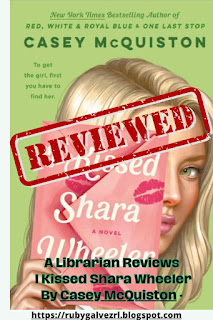
Casey McQuiston's "I Kissed Shara Wheeler" is a compelling read that delves into the complexities of young love, identity, and the pursuit of self-discovery. The narrative is imbued with a sense of urgency and emotional depth that captures the reader's attention from the get-go. McQuiston's storytelling prowess shines through, making it a standout in the young adult romance genre.

One of the most commendable aspects of the book is its nuanced portrayal of characters. Shara Wheeler is not just another love interest; she's a multi-dimensional character with her own dreams, fears, and complexities. This adds a layer of realism to the story, making it relatable to a broad spectrum of readers.

The Challenges: A Double-Edged Sword

However, the book is not without its challenges. The pacing can be a bit uneven, with some sections dragging on longer than necessary. This can be particularly taxing for readers who prefer a more streamlined narrative. Additionally, the book employs a series of flashbacks that, while enriching the story, can sometimes disrupt the flow and make it harder to follow.

Real-Life Relevance

What sets "I Kissed Shara Wheeler" apart is its relevance to real-life situations. The story tackles issues like identity, societal expectations, and the complexities of young love, which resonate with many readers. It serves as a mirror reflecting the trials and tribulations that come with navigating relationships and personal growth during one's formative years.

Comparative Analysis

When compared to other books in its niche, such as "To All the Boys I've Loved Before" by Jenny Han or "Simon vs. the Homo Sapiens Agenda" by Becky Albertalli, "I Kissed Shara Wheeler" holds its own. While the aforementioned titles focus more on the lighter aspects of young love, McQuiston's work delves deeper into the emotional and psychological facets of relationships. This gives it a unique edge, making it a must-read for those who appreciate depth in their romantic reads.

Final Thoughts

In conclusion, "I Kissed Shara Wheeler" is a compelling narrative that offers a balanced mix of romance, drama, and real-life relevance. Its strengths lie in its well-developed characters and emotional depth, although it does suffer from some pacing issues and narrative complexities. Nonetheless, it's a book that leaves a lasting impression, making it a worthwhile addition to the young adult romance canon.

I hope you find this review insightful and engaging. Whether you're a college student looking for a relatable read or a parent seeking to understand the literary tastes of the younger generation, "I Kissed Shara Wheeler" offers something for everyone.

Popular posts from this blog

3 Easy Ways to Instantly Improve Your Handwriting

Handwriting doesn’t have to be a lost art, even in today’s digital world. Whether you’re taking notes, writing a letter, or just doodling in your journal, legible handwriting is a skill worth mastering. Let’s start with three quick tips to make your writing more readable: 1. Pay Attention to Spacing Spacing is one of the most overlooked aspects of legibility. It’s tempting to let your letters and words run together, but that’s the quickest way to turn your notes into an indecipherable mess. Make a conscious effort to leave some space between each letter and word. This breathing room allows the reader to clearly distinguish one word from the next. Slow down, and you’ll find your spacing naturally improves. 2. Hold the Pen Correctly You might not think much about how you hold your pen, but it plays a big role in your handwriting. Too tight a grip, and your hand tires quickly, causing shaky lines. Too loose, and you’ll struggle to control the pen. Aim for a relaxed but steady grip that le...

A Librarian’s Method for Organizing a Wardrobe: Current, Non-current, or Archive?

I did not set out to fix my wardrobe. I was just tired of negotiating with it every morning. My closet was full, but I wore the same few things. The rest stared back at me like a group project I never agreed to join. I had already tried the usual advice: declutter, be ruthless, imagine an ideal self who attends brunch more often than I do.  None of it stuck. Then I realized the problem was not the clothes. It was the lack of a system.  I am a librarian. When something does not work, I do not add more space. I reclassify. Again, I remind myself that I am a librarian. When something is chaotic, my first thought is NOT “buy more storage.” It is “this needs a system.” My closet did not need more hangers. It needed cataloging. Librarians do not panic about having too many books. They decide where each book belongs:  current , non-current , or archive .  So I tried the same method on my wardrobe. The Library Method, Explained Without the Jargon In libraries: Current ...

10 Occult Books That Can Be Classified Under LCC G

If you hear the word “occult,” you might imagine dark rooms, candles, and someone whispering Latin badly. But in library science, the occult often sits quietly under LCC Class G — the section for Geography, Anthropology, and Folklore . Why? Because many occult works deal with myth, symbolism, ritual, cultural belief systems, and human attempts to understand the unseen. In other words, they are less about flying broomsticks and more about how people make meaning. Here are ten notable occult books that can reasonably fall under LCC G , especially within folklore (GR), customs (GT), or cultural anthropology. 1. The Golden Bough – James George Frazer Frazer’s massive comparative study of myth and religion explores magic, ritual sacrifice, fertility rites, and sacred kings. It is not a spell book. It is anthropology with a dramatic flair. Why LCC G? Because it analyzes myth and ritual across cultures. This comfortably sits in folklore and anthropology (GR). 2. The Hero with a Thousand Face...

5 Books That Make You Better at Getting Things Done

1. The Power of Full Engagement by Jim Loehr and Tony Schwartz This book says energy is more important than time. Weird, right? But it makes sense. The authors say we should work like athletes — focus hard for a bit, then take real breaks to rest and recharge. Instead of running on empty all week, you learn to build routines that give you energy, not drain it. Basically, it’s saying: stop acting like a robot and start acting like a human who takes naps. 2. Getting Things Done by David Allen If your brain feels like a messy desk full of sticky notes, this book is your cleaning guide. David Allen teaches you how to put every task, idea, or reminder somewhere safe — so your mind can finally relax. Once you’ve written everything down, you can actually focus on what’s in front of you instead of wondering what you forgot. It’s for people who want to feel calm, in control, and slightly smug about their tidy to-do lists. 3. The Effective Executive by Peter Drucker Peter Drucker is...

How Important is Proper Document Control in ISO Accreditation?

If your organization is working toward ISO accreditation—or trying to maintain it—you’ve probably heard the phrase document control more times than you care to count. But before your eyes glaze over, let’s break it down. ISO standards (like ISO 9001 for quality management, ISO 14001 for environmental management, or ISO 27001 for information security) are built on the idea of consistency, traceability, and accountability. None of that works without proper documentation. And documentation doesn’t stay proper on its own. It needs structure. That’s where document control comes in. So, how important is it? In short: it's everything. What Is Document Control in the ISO Context? Document control refers to how an organization manages its critical documents—such as procedures, manuals, forms, and records—so that they are: Correct (the latest version) Accessible (to the right people) Secure (from unauthorized changes) Traceable (who approved, changed, or accessed them)...

Being a Document Control Officer to Manage Archives: Are You the Office Librarian?

In many workplaces, there's someone who seems to know where everything is. They can pull up the latest policy revision, retrieve an outdated client file, or point you to that mysterious "blue folder" from three years ago that somehow still matters. This person may not wear glasses or whisper "shhh"—but in essence, they are the office librarian . In most cases, this role falls to the Document Control Officer . But what does being a Document Control Officer really mean? And how close is it to being the keeper of a corporate library? Let’s unpack it. What Is a Document Control Officer? A Document Control Officer (DCO) is responsible for managing how documents are created, reviewed, stored, accessed, and archived within an organization. In many cases, the DCO is the quiet force behind regulatory compliance, internal consistency, and institutional memory. In short, if your company ever says, “We have a paper trail,” the DCO is why. Their duties typically incl...

The Importance of Monitoring Access to Organizational Archives

In any organization, the preservation and management of archives is a task that requires meticulous attention and responsibility, particularly when it comes to monitoring who accesses these valuable records. As a record manager, one of the crucial aspects of the role is ensuring that the access to archives is both controlled and recorded. This blog post explores why it's essential for record managers to keep track of who accesses organizational archives and the benefits this control brings. By the way, I designed an Archives Log Book that can help record keepers monitor who accesses their archives, especially the ones stored on-site in boxes or file cabinets:  https://www.amazon.com/Archives-Log-Book-Organizational-Unauthorized/dp/B0B35H8P6L  Protecting Sensitive Information Organizational archives often contain sensitive information, which could include personal data, confidential business strategies, legal documents, and financial records. Unauthorized access to such informa...

Many Kinds of Librarian Jobs

  What are the types of librarians? Are there more than one type? It may seem like a one-size-fits-all profession, but many kinds exist. Each kind has responsibilities unique to it. Academic librarians These types of librarians are those who are in charge of college and university libraries. It is rare for academic librarians to work alone because the workload is just too much. Library aides, internet staff, catalogers, book binders, and even abstractors and indexers are often found in tertiary education libraries. Usually, there is a hierarchy in an academic library; there is a head librarian and one or several other librarians. Academic librarians may also enjoy benefit of having student assistants. Public librarians These types of librarians are those who are in charge of public libraries (city, municipal, provincial, and congressional libraries). They’re considered elite in the profession because snagging a job in a public library means enjoying the benefits of working for the ...

Simple Way to Ask Library Users to Rate the Library Service

  Library users do not always share their thoughts on how the librarian or school can improve their library service. In fact, some won't ever, unless prompted. Soliciting their thoughts using a suggestion box is also not as good a strategy as it is predicted to be. After all, the blank piece of paper near the suggestion box doesn't really guide the user. I also noticed that users would only use the suggestion box if they have a complaint, but not if they just want to go about their business and leave.  There must be a more pro-active way to solicit users' opinion.  A simple solution would be to offer a short survey to measure how successfully users were able to complete some common activities in the library. This assessment uses the Likert scale, which is typically a five, seven, or nine-point agreement scale used to measure respondents' agreement with various statements. For example, the scale can range from "very unsuccessful" to "very successful."...

Storytelling Appeal Rating for Roronoa Zoro of One Piece

[Warning: this post may contain spoilers] Roronoa Zoro: The Three-Sword Wielding Swordsman – A Storytelling Appeal Rating From his initial appearance in "One Piece," Roronoa Zoro, the enigmatic swordsman with a dream as sharp as his blades, has been a character of immense intrigue and complexity. His unique fighting style, unwavering determination, and deep sense of honor make him an indispensable part of the Straw Hat Pirates. Zoro's Storytelling Appeal Rating stands impressively at 9/10, a testament to his impact on the narrative and his resonance with the audience. Introduction and Characterization: Zoro is introduced as a fearsome pirate hunter, yet he is quickly revealed to be a man of deep principles and loyalty. Bound by a vow to his late childhood friend, he dreams of becoming the world's greatest swordsman. This blend of fierce ambition and poignant motivation sets Zoro apart from typical action-oriented characters. Combat Skills and Unique Style: Zoro's ...